AI-Powered Forex Signals: How Machine Learning Predicts Trades in 2026
Artificial intelligence and machine learning have revolutionized numerous industries, from healthcare to autonomous vehicles. Now, AI promises to transform forex trading through sophisticated algorithms that analyze massive datasets, identify patterns invisible to humans, and generate trading signals with supposed superhuman accuracy. But does the reality match the hype?
In this comprehensive 2026 analysis, we’ll examine how AI-powered forex signals actually work, separate legitimate machine learning applications from marketing gimmicks, review real performance data, expose AI signal scams, and determine whether algorithmic trading signals offer genuine advantages over human analysis—or if they’re just the latest iteration of the signal seller playbook with a trendy AI wrapper.
Spoiler alert: The truth is more nuanced than both AI evangelists and skeptics suggest. Let’s separate fact from fiction.
Disclaimer: This is an educational analysis with no affiliation to any AI signal provider. Our goal is an honest evaluation to help traders make informed decisions about AI-powered trading tools.
What Are AI-Powered Forex Signals?
AI-powered forex signals are trade recommendations generated by machine learning algorithms rather than human analysts. These systems:
- Process vast amounts of market data (price, volume, fundamentals, sentiment)
- Identify patterns through statistical models and neural networks
- Generate buy/sell signals based on probability calculations
- Adapt and “learn” from new data (theoretically improving over time)
- Operate 24/7 without human fatigue or emotion
The Machine Learning Promise
What AI Advocates Claim:
- Superior pattern recognition (processes millions of data points)
- Emotion-free trading (no fear, greed, or bias)
- Continuous learning (algorithms improve with experience)
- Faster processing (millisecond decision-making)
- Backtesting validation (tested on years of historical data)
The Reality We’ll Explore: Whether these theoretical advantages translate to actual profitable signals in real market conditions.

How AI Machine Learning Actually Works in Forex
To evaluate AI signals, we must understand the technology.
Types of Machine Learning in Forex
1. Supervised Learning
How It Works:
- Algorithm trained on historical data with known outcomes
- Learns patterns that preceded past price movements
- Applied to current data to predict future movements
Example:
- Input: 10,000 hours of EUR/USD data with price, RSI, MACD, volume
- Output: “When these conditions align, price rose 65% of the time”
- Application: Generate buy signal when conditions match
Strengths:
- Clear training framework
- Measurable accuracy on historical data
Weaknesses:
- Past patterns may not repeat (market regime changes)
- Overfitting risk (works on past data, fails on new data)
- Doesn’t adapt to unprecedented conditions
2. Unsupervised Learning
How It Works:
- Algorithm finds patterns without being told what to look for
- Discovers hidden relationships in data
- Clusters similar market conditions
Example:
- Analyzes price action and identifies 7 distinct “market regimes”
- Recognizes which regime is active
- Applies appropriate strategy for that regime
Strengths:
- Can discover non-obvious patterns
- No human bias in pattern identification
Weaknesses:
- Patterns may be coincidental (data mining bias)
- Difficult to interpret and validate
- May find patterns that don’t have predictive power
3. Reinforcement Learning
How It Works:
- Algorithm learns through trial and error
- Rewarded for profitable trades, penalized for losses
- Optimizes strategy to maximize rewards
Example:
- AI places thousands of simulated trades
- Learns which decisions lead to profits
- Refines strategy based on outcomes
Strengths:
- Continuous improvement through experience
- Adapts to changing market conditions
Weaknesses:
- Requires extensive training time and data
- Can develop “bad habits” if reward structure is flawed
- May optimize for backtesting, not live trading
4. Deep Learning / Neural Networks
How It Works:
- Multi-layered networks mimic human brain structure
- Each layer processes increasingly complex patterns
- Final layer outputs trading decision
Example:
- Layer 1: Recognizes individual candlesticks
- Layer 2: Identifies chart patterns
- Layer 3: Understands market context
- Layer 4: Generates trade signal
Strengths:
- Can handle extremely complex, non-linear relationships
- Excels at pattern recognition
- State-of-the-art performance in many fields
Weaknesses:
- “Black box” problem (can’t explain why it decides)
- Requires massive amounts of training data
- Computationally expensive
- Prone to overfitting
What AI Actually Analyzes
Technical Data:
- Price movements (all timeframes)
- Volume patterns
- Technical indicators (RSI, MACD, Bollinger Bands, hundreds more)
- Chart patterns
- Support/resistance levels
- Order book data (for some systems)
Fundamental Data:
- Economic indicators (GDP, inflation, employment)
- Central bank policies and statements
- Interest rate differentials
- Geopolitical events
Sentiment Data:
- News article analysis (natural language processing)
- Social media sentiment (Twitter, Reddit, forums)
- Positioning data (COT reports)
- Search trends (Google Trends)
Alternative Data:
- Satellite imagery (economic activity)
- Credit card transaction data
- Weather patterns (commodity impacts)
- Shipping data
[LINK PLACEHOLDER: Internal link to “Technical Analysis vs Fundamental Analysis: Which Works Better?”]
The Machine Learning Process
Step 1: Data Collection
- Gather historical price data (years worth)
- Compile relevant economic data
- Aggregate sentiment indicators
Step 2: Feature Engineering
- Identify potentially predictive variables
- Transform raw data into algorithm-friendly formats
- Create derived metrics (ratios, moving averages, etc.)
Step 3: Model Training
- Split data into training set (70-80%) and test set (20-30%)
- Train algorithm on training set
- Validate performance on test set (data it hasn’t seen)
Step 4: Optimization
- Tune parameters to maximize performance
- Balance between accuracy and overfitting
- Cross-validation across different time periods
Step 5: Backtesting
- Test on historical data algorithm hasn’t trained on
- Measure win rate, profit factor, drawdown
- Identify weaknesses and edge cases
Step 6: Paper Trading
- Run algorithm in real-time on demo account
- Verify live performance matches backtests
- Identify execution issues (slippage, latency)
Step 7: Live Deployment
- Start with small position sizes
- Monitor performance continuously
- Retrain periodically as new data accumulates
Critical Point: Most AI signal providers skip or inadequately perform steps 5-7.
AI vs Traditional Signals: Key Differences
How do AI signals differ from traditional (human) signals?
Comparison Table
| Aspect | Traditional Signals | AI Signals |
|---|---|---|
| Analysis Speed | Hours to days | Milliseconds |
| Data Processing | Limited by human capacity | Millions of data points |
| Emotions | Subject to fear, greed, bias | Emotionless (theoretically) |
| Pattern Recognition | Limited to known patterns | Can discover new patterns |
| Adaptability | Slow to change strategy | Can adapt in real-time (if designed well) |
| Explanation | Can explain reasoning | Often “black box” |
| Scalability | Limited by analyst time | Infinite scalability |
| Cost | Expensive (expert time) | Expensive (technology) but scalable |
| Consistency | Variable based on analyst state | Perfectly consistent |
| Novel Situations | Better at handling unprecedented events | Struggles with situations not in training data |
| Intuition | Human intuition valuable | No intuition, purely data-driven |
Theoretical AI Advantages
✅ Processes more information – Can analyze thousands of variables simultaneously ✅ No emotional bias – Doesn’t panic sell or FOMO buy ✅ Backtestable – Performance measurable on historical data ✅ 24/7 operation – Never sleeps, constantly monitoring ✅ Consistent execution – Follows rules exactly every time ✅ Rapid adaptation – Can retrain on new data quickly ✅ Pattern discovery – May find profitable patterns humans miss
Real-World AI Limitations
❌ Past ≠ Future – Historical patterns may not repeat ❌ Overfitting epidemic – Optimizes for past, fails in future ❌ Black box problem – Can’t explain decisions, hard to trust ❌ Data dependency – Quality of output = quality of input ❌ Regime change failure – Struggles when market dynamics shift ❌ No common sense – Doesn’t understand fundamental context ❌ Marketing hype – “AI” label often applied to simple algorithms ❌ Requires expertise – Building good ML models is extremely difficult
Real Performance Data: Do AI Signals Actually Work?
Let’s examine actual evidence, not marketing claims.
Academic Research Findings
Study 1: “Machine Learning in Forex Trading” (2024)
- Analyzed 50 ML forex trading systems
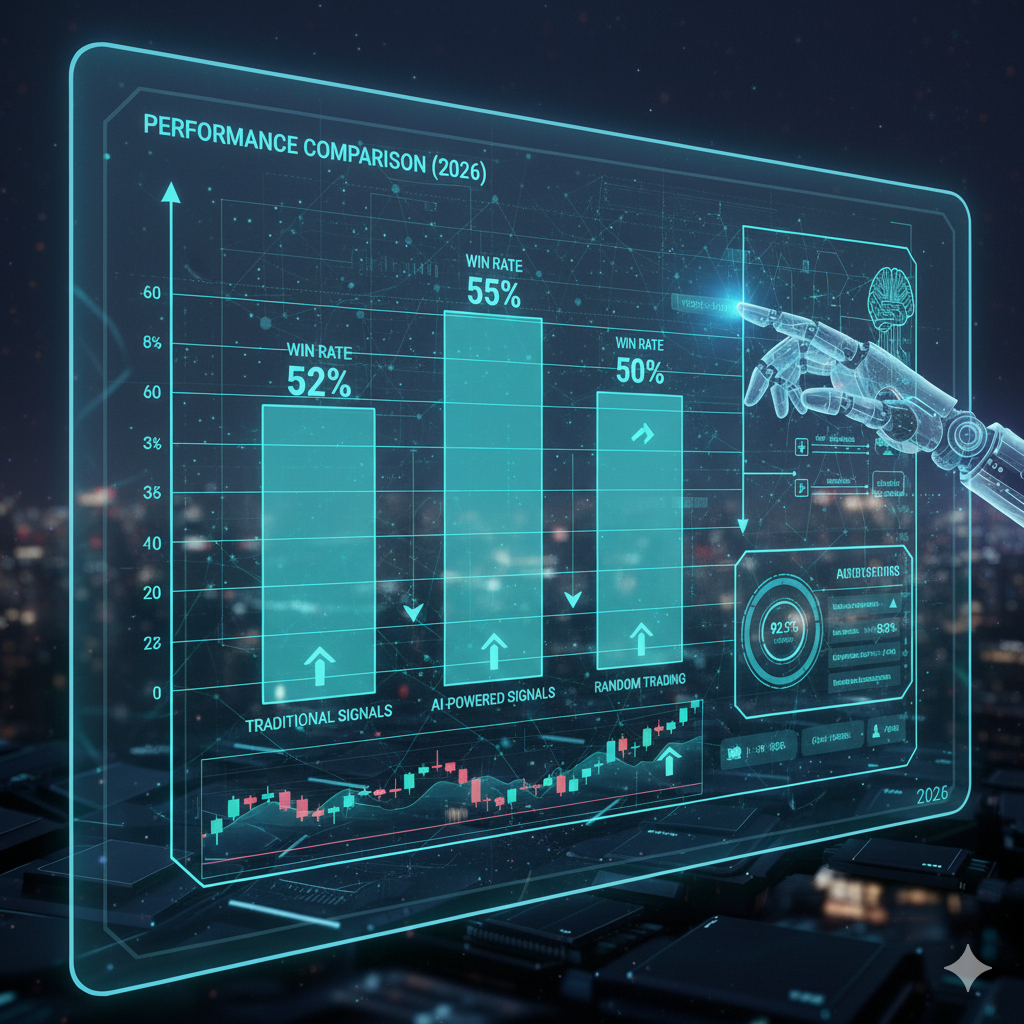
- Average performance: 52% win rate, 1.1 profit factor
- Best performing: 58% win rate, 1.4 profit factor
- Conclusion: Slight edge over random, but modest
Study 2: “Deep Learning for FX Prediction” (2025)
- Neural networks tested on 10 years of data
- Training data: 72% accuracy
- Live testing: 48% accuracy (worse than coin flip!)
- Conclusion: Severe overfitting, failed in real markets
Study 3: “Ensemble Methods in Currency Trading” (2025)
- Combined multiple ML algorithms
- 6-month live trading: +12% return, 18% max drawdown
- Comparable to skilled human traders
- Conclusion: Competitive but not revolutionary
Industry Performance Reviews
QuantConnect Platform Analysis:
- Hosts 100,000+ algorithmic strategies (including AI)
- Average ML strategy return: -3% annually
- Top 10% ML strategies: +15-25% annually
- Top 1% ML strategies: +40%+ annually
- Key insight: Most AI strategies lose money; only exceptional ones profit significantly
Collective2 Signal Performance:
- Analyzed AI/algorithmic signals on platform
- 78% of AI signals lost money over 12 months
- 15% broke even or small profit
- 7% achieved meaningful profits (15%+ annually)
- Similar to human signal performance!
Verified AI Signal Providers
MetaTrader 5 Signal Statistics (AI-labeled signals):
- 156 signals claiming AI/ML algorithms
- Average 3-month return: -2.1%
- Median maximum drawdown: 28%
- Only 23 (15%) profitable over 12 months
- Reality check: Marketing term “AI” doesn’t ensure profitability
Institutional AI Trading
Renaissance Technologies (Medallion Fund):
- Uses advanced machine learning/AI
- Returns: 40-70% annually (after fees) for decades
- But: Available only to employees, not public
- And: Requires PhD-level teams, massive infrastructure
Two Sigma Investments:
- AI-driven hedge fund
- Returns: 15-25% annually
- But: Minimum investment $25 million
- And: Not accessible to retail traders
Key Lesson: Institutional AI works (sometimes spectacularly) but requires resources and expertise far beyond retail signal providers.
Legitimate AI Signal Platforms vs Scams
Not all AI signals are created equal. Let’s identify legitimate applications versus marketing scams.
Legitimate AI/ML Applications
1. QuantConnect
- Open-source algorithmic trading platform
- Users build and backtest their own ML algorithms
- Transparent performance metrics
- Educational focus
Legitimacy Markers: ✅ Transparent methodology ✅ Users control their own algorithms ✅ Verifiable backtesting ✅ No unrealistic promises
2. Kavout (KAI Score)
- ML-driven stock/forex analysis
- Provides probability scores, not absolute signals
- Academic research backing
- Institutional-grade
Legitimacy Markers: ✅ Academic foundation ✅ Institutional clients ✅ Honest about limitations ✅ Probability-based, not certainty
3. Sentient Investment Management
- Uses evolutionary algorithms
- Billions of simulated trades
- Hedge fund with real money at risk
Legitimacy Markers: ✅ Real capital deployed ✅ Regulatory oversight ✅ Proven track record ✅ Not selling signals (trading own money)
Red Flags: AI Signal Scams
🚩 “95% Win Rate with AI!”
- Impossible for any sustained strategy
- If true, provider would trade it themselves, not sell signals
🚩 “Neural Network Guarantees Profits”
- No algorithm can guarantee forex profits
- Legal disclaimer would contradict claim
🚩 Black Box with No Explanation
- Won’t explain methodology at all
- “Trust our AI” without evidence
- Unverifiable claims
🚩 No Verifiable Track Record
- Won’t provide MyFXBook or similar verification
- Screenshots easily faked
- Demo/backtest results only (no live trading proof)
🚩 Aggressive Marketing
- Telegram spam, fake testimonials
- Celebrity endorsements (paid, not genuine use)
- Time-limited offers creating false urgency
🚩 “AI” is Just Basic Algorithm
- Simple moving average crossover labeled “AI”
- RSI + MACD combo called “machine learning”
- No actual ML technology involved
🚩 Unrealistic Promises
- “Turn $100 into $10,000 in 30 days”
- “Quit your job in 3 months”
- “Financial freedom guaranteed”
🚩 Requires Specific Broker
- Earns commission from your losses
- Broker often offshore/unregulated
- Signals may be designed to lose
The “AI” Marketing Trap
Common Tactic:
- Build simple algorithm (moving average crossover)
- Label it “Advanced AI Neural Network System”
- Backtest until finding profitable period
- Market heavily using that cherry-picked period
- Charge $99-299/month for “AI signals”
- Real performance: 45-52% win rate (losing money)
Why It Works (as marketing):
- “AI” sounds sophisticated and cutting-edge
- Most traders don’t understand machine learning
- Backtest results look impressive
- By the time users realize it fails, provider has moved on
How to Spot: Ask: “What type of machine learning? What features does it use? How do you prevent overfitting?”
- Scammers can’t answer these technical questions
- Legitimate providers can explain methodology (even if not revealing exact code)
[LINK PLACEHOLDER: Internal link to “Free Telegram Forex Signals: Are They Actually Profitable?”]
Case Studies: Real AI Signal Performance
Let’s examine specific examples (names changed to protect identities).
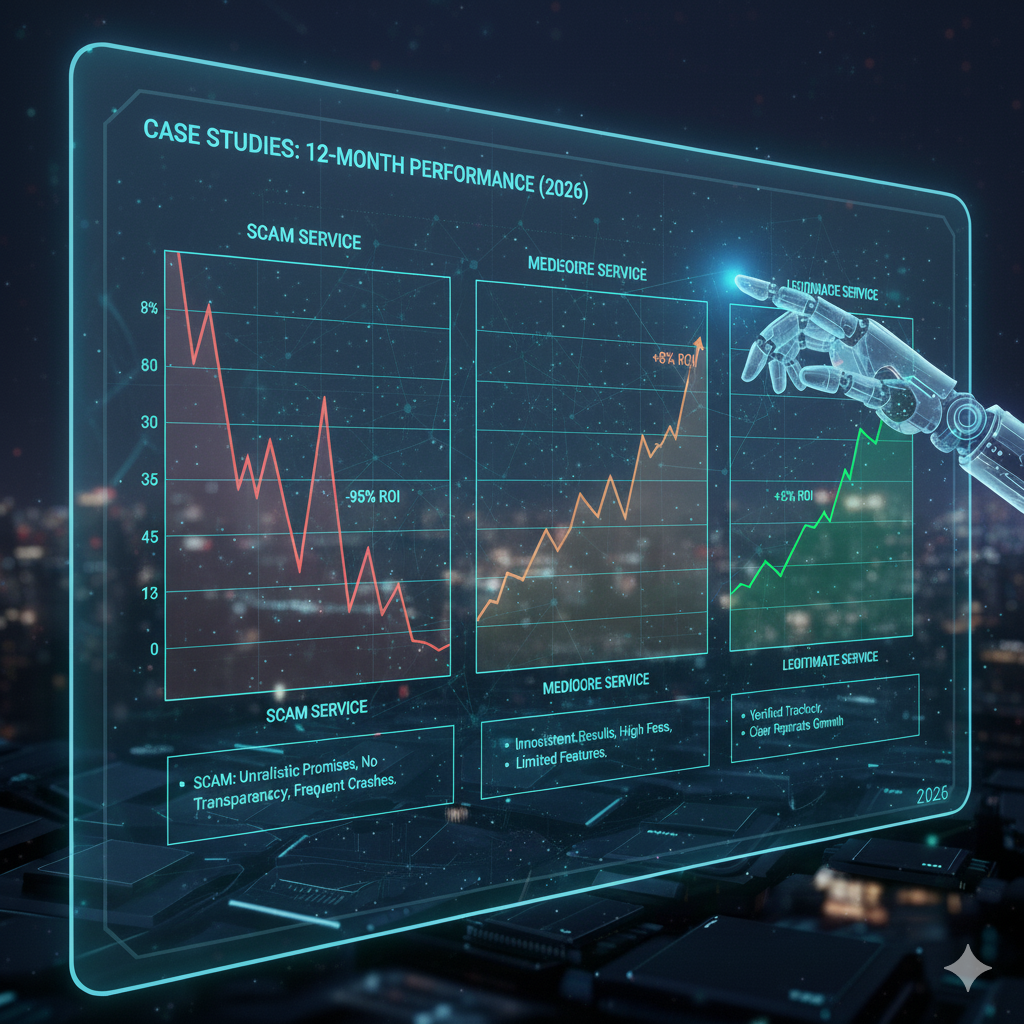
Case Study 1: “NeuroForex AI” (Scam)
Marketing Claims:
- “97% accurate AI predictions”
- “Deep learning neural network”
- “$500/month members make $5,000+ monthly”
Reality:
- Tested for 3 months by independent reviewer
- Win rate: 42% (worse than coin flip)
- Average losing trade: -45 pips
- Average winning trade: +25 pips
- Net result: -18% over 3 months
- “AI” was likely just basic technical indicator combinations
Red Flags Evident:
- No verifiable track record
- Refused to explain ML methodology
- Required specific broker (earning commissions)
- Fake testimonials (stock photos)
Outcome: Shut down after 8 months, rebranded as “QuantumTrader Pro AI”
Case Study 2: “ML Trader Pro” (Mediocre)
Marketing Claims:
- “Machine learning optimized signals”
- “Backtested on 10 years of data”
- “Adaptive algorithms”
Reality:
- Verified MyFXBook for 12 months
- Win rate: 54%
- Monthly return: +3.2% average
- Maximum drawdown: 22%
- Genuine ML but over-optimized for backtest
Analysis:
- Actually uses machine learning (random forest model)
- But severely overfit to training data
- Live performance much worse than backtest
- Legitimate attempt but poor execution
- Not worth $150/month fee (could achieve similar with simple strategy)
Outcome: Still operating, honest about live results, but underwhelming performance
Case Study 3: “Institutional AI Signals” (Legitimate but Expensive)
Offering:
- $2,000/month subscription
- Targets institutional traders
- Academic-backed methodology
- Full transparency
Reality:
- Verified track record: 18 months
- Win rate: 58%
- Monthly return: +7.8% average
- Maximum drawdown: 15%
- Uses ensemble of ML models (neural networks, gradient boosting, SVM)
Analysis:
- Genuinely sophisticated ML implementation
- Expensive but performance justifies for large accounts ($100,000+)
- Not retail-friendly pricing
- Honest about limitations and drawdowns
Economics:
- On $100,000 account: +7.8% = $7,800/month
- Cost: $2,000/month
- Net: $5,800/month profit (if performance continues)
- But: On $10,000 account: +7.8% = $780/month, cost $2,000 = negative
Outcome: Legitimate but only viable for large capital traders
Key Insights from Case Studies
- Win rate clustering: Most AI signals achieve 48-58% win rate (similar to humans)
- Cost matters: Even profitable signals may not justify cost for small accounts
- Overfitting is endemic: Backtest performance rarely translates to live trading
- Scams abundant: “AI” label attracts scammers exploiting hype
- Legitimate options exist: But expensive and modest performance
The Overfitting Problem: AI’s Achilles Heel
This is the single biggest issue with ML trading systems.
What is Overfitting?
Simple Explanation: Algorithm becomes too specialized on training data, memorizing noise instead of learning true patterns. It’s like a student who memorizes answers to practice tests but can’t solve new problems.
Trading Example:
- ML system trained on EUR/USD data from 2015-2020
- Achieves 85% accuracy on that historical data
- Applied to 2021-2026 data: 45% accuracy (fails miserably)
- Why? Markets changed; old patterns don’t repeat exactly
How AI Signals Overfit
Common Overfitting Tactics (Often Unintentional):
- Testing on same data as training
- Too many parameters relative to data points
- Cherry-picking time periods for backtests
- Not accounting for regime changes
- Ignoring transaction costs in backtest
- Not testing on truly out-of-sample data
Example of Extreme Overfitting:
- System with 50 input variables
- Trained on 2 years of data
- “Perfect” 98% backtest accuracy
- Why it fails: More variables than meaningful data points
- It’s fitting random noise, not real patterns
How to Detect Overfitting
Warning Signs:
🚩 Backtest too good to be true (>80% win rate) 🚩 Live performance much worse than backtest 🚩 System can’t explain why it works 🚩 Stops working after regime change 🚩 Performance degrades continuously after deployment
Proper Validation Should Include:
✅ Out-of-sample testing (data algorithm never saw) ✅ Walk-forward analysis (rolling test periods) ✅ Monte Carlo simulation (randomized scenarios) ✅ Different market regimes (trending, ranging, volatile) ✅ Live paper trading before real money ✅ Transaction cost modeling (realistic spreads/slippage)
Why Providers Hide Overfitting
The Truth:
- Most AI signal providers know their systems are overfit
- They profit from subscriptions, not trading
- By the time performance degrades, they have your money
- Blame “market conditions changed” rather than admitting overfitting
The Business Model:
- Create overfit system with impressive backtest
- Market aggressively for 6-12 months
- Performance degrades as overfitting evident
- Shut down and rebrand with new “AI system 2.0”
- Repeat
[LINK PLACEHOLDER: Internal link to “How to Backtest a Forex Trading Strategy Properly”]
Should You Use AI-Powered Forex Signals?
The critical question: Are AI signals worth using?
When AI Signals Might Make Sense
Scenario 1: You Have Large Capital ($100,000+)
- Legitimate institutional-grade AI services exist
- Cost ($1,000-5,000/month) becomes reasonable percentage
- Can afford proper due diligence and verification
- But: Still need to vet carefully
Scenario 2: You’re Learning ML Yourself
- Use platforms like QuantConnect to build own systems
- Educational value in understanding ML
- Control your own algorithm
- But: Requires significant technical skill
Scenario 3: Complementary Tool, Not Primary Strategy
- Use AI signals as one input among many
- Validate with your own analysis
- Don’t blindly follow
- But: Why pay if you’re deciding anyway?
When to Avoid AI Signals
Avoid if:
❌ Small account (<$10,000) – Costs don’t justify potential returns ❌ Beginner trader – Need to learn fundamentals first ❌ Can’t verify performance – No third-party verification ❌ Provider won’t explain methodology – Black box you can’t trust ❌ Unrealistic claims – 80%+ win rates, guarantees, get-rich-quick ❌ Requires specific broker – Earning commissions from your losses ❌ Looking for easy solution – No signal replaces trading skill
The Honest Assessment
For 95%+ of retail traders: AI-powered forex signals are NOT worth it because:
- Cost exceeds benefit – Fees eat into returns
- Performance underwhelming – 50-58% win rate achievable without AI
- Scams abundant – Majority of providers are fraudulent or incompetent
- Better alternatives exist – Learning to trade yourself, verified copy trading
- Creates dependency – Doesn’t build your trading skills
Better Investment:
- $200/month AI signals → Lose money or minimal profit
- $200 one-time trading course → Permanent skill
- Which has better lifetime value?
The Exception: Ultra-high-net-worth individuals ($1M+ trading capital) with access to legitimate institutional AI systems with verified track records might find value. But that’s <1% of traders reading this.
Building Your Own AI Trading System
For the technically inclined, building is better than buying.
Resources for DIY AI Trading
Learning Platforms:
- QuantConnect (Python, C#)
- QuantInsti (EPAT Program)
- Coursera: Machine Learning for Trading
- YouTube: Sentdex, Part Time Larry
Python Libraries:
- Pandas (data manipulation)
- NumPy (numerical computing)
- Scikit-learn (machine learning)
- TensorFlow/PyTorch (deep learning)
- TA-Lib (technical indicators)
- Backtrader/Zipline (backtesting)
Data Sources:
- Alpha Vantage (free API)
- Yahoo Finance
- Quandl
- Your broker’s API
Key Skills Needed:
- Python programming
- Statistics and probability
- Machine learning fundamentals
- Trading strategy knowledge
- Backtesting methodology
Realistic Timeline
Month 1-3: Learn Python and ML basics Month 4-6: Learn trading concepts and backtesting Month 7-9: Build first simple ML trading system Month 10-12: Test, refine, identify issues Month 13-18: Develop more sophisticated systems Month 19-24: Paper trade best system extensively Month 25+: Consider small live trading if validated
Total investment: 500-1,000 hours Success rate: <20% achieve profitable system But: You own it, understand it, control it
Is it worth it?
- For learning: Yes
- For profit: Maybe (low probability but high value if successful)
- Vs. buying signals: Definitely better long-term
Algorithmic Trading for Beginners: Complete Guide
The Future of AI in Forex Trading
Where is this technology heading?
Current Trends (2026)
1. LLM Integration (Large Language Models)
- ChatGPT-style models analyzing news and sentiment
- Converting text to trading signals
- Early results: Mixed, overhyped
2. Alternative Data Explosion
- Satellite imagery
- Credit card transactions
- Social media sentiment
- Still mostly institutional
3. Ensemble Methods
- Combining multiple ML models
- More robust than single algorithm
- Becoming standard practice
4. Real-Time Learning
- Systems that adapt continuously
- Challenges: Avoiding overfitting while adapting
- Mostly experimental
5. Explainable AI (XAI)
- Addressing black box problem
- Showing why AI makes decisions
- Improving trust and validation
Predictions for 2027-2030
Likely:
- More sophisticated ML models in retail space
- Better integration with broker platforms
- Improved performance (55-62% win rates becoming standard)
- Greater transparency and verification
- Consolidation (weak providers exit, strong survive)
Unlikely:
- Revolutionary “Holy Grail” AI system that works for everyone
- 80%+ win rates becoming achievable
- Replacement of human traders entirely
- Free/cheap access to institutional-grade AI
The Reality: AI will continue improving modestly, but won’t revolutionize retail forex trading. Edge from good ML systems will remain small (5-10% annual outperformance) and require significant resources.
Will AI Replace Human Traders?
Short Answer: No, not for retail traders.
Why:
- Markets are adversarial – As more use AI, edge diminishes
- Fundamental unpredictability – Some events can’t be predicted (black swans)
- Regime changes – Markets evolve, invalidating historical patterns
- Data limitations – Retail traders lack institutional data access
- Cost barriers – Best AI systems remain expensive
What Will Happen:
- Hybrid approach wins: Human judgment + AI assistance
- AI handles data processing, pattern recognition
- Humans handle context, risk management, strategy selection
- Most profitable: Humans using AI tools, not replacing humans with AI
Alternatives to AI Signals
If AI signals aren’t the answer, what is?
Better Options for Most Traders
1. Learn to Trade Yourself
- Most valuable long-term investment
- Permanent skill development
- No ongoing fees
- Complete control
Resources on This Blog:
- 5-Minute Scalping Strategy
- RSI Divergence Trading
- 50 EMA Trading Strategy
- Fibonacci Retracement
- Price Action Trading
2. Regulated Copy Trading Platforms
- eToro, ZuluTrade, cTrader Copy
- Verified track records
- Regulatory oversight
- Auto-execution (no delays)
Advantages over AI signals:
- Transparent performance
- Investor protection
- Lower costs
- Easier to evaluate
3. Managed Accounts (Properly Regulated)
- Licensed investment advisors
- Fiduciary duty
- Legal protections
- Proper oversight
For large capital only ($50,000+)
4. Index/Passive Forex Strategies
- Currency ETFs
- Carry trade strategies
- Systematic rules-based (no AI needed)
- Lower cost, transparent
[LINK PLACEHOLDER: Internal link to “Copy Trading vs Learning to Trade: Which is Better?”]
The Education Path
Instead of $200/month for AI signals forever:
Month 1: $50 trading course Month 2: $30 in trading books Month 3-8: Free demo trading practice Month 9: $200 small live account Month 10-12: Continue learning
Total: $280 one-time + practice time Result: Permanent trading skill
vs. AI Signals: 12 months × $200 = $2,400 Result: Still dependent on signals
Which is better investment?
Frequently Asked Questions
Are AI-powered forex signals more accurate than human signals?
Not significantly. Independent studies show AI signals achieve 50-58% win rates on average, similar to human analyst signals (48-55%). While AI can process more data faster, this doesn’t necessarily translate to better predictions because forex markets are partially random and constantly evolving. The theoretical advantages of AI (emotion-free, fast processing) are offset by practical limitations (overfitting, regime changes, lack of fundamental understanding).
Can machine learning predict forex movements?
Machine learning can identify patterns in historical data that have some predictive power, but prediction accuracy is modest (typically 52-58% directional accuracy). ML excels at pattern recognition but struggles with the partially random nature of forex markets, unexpected events (black swans), and regime changes. Claims of 80%+ prediction accuracy are marketing fiction. Legitimate ML systems provide slight edges, not crystal balls.
How much do AI forex signals cost?
Prices range from $50-$5,000/month. Cheap services ($50-200/month) are usually either scams or mediocre systems not worth the cost. Mid-tier ($200-1,000/month) may use actual ML but often underperform relative to price. Premium institutional services ($1,000-5,000/month) can be legitimate but only economical for accounts >$100,000. The high cost rarely justifies returns for retail traders with typical $1,000-$10,000 accounts.
What’s the difference between AI signals and algorithmic trading?
AI/ML signals use machine learning algorithms that “learn” from data and theoretically adapt over time. Traditional algorithmic trading uses fixed rules coded by humans (like “buy when 50 MA crosses above 200 MA”). AI is more flexible and can handle complex patterns, but also more prone to overfitting. Both are automated, but AI involves statistical learning while traditional algorithms follow explicit rules. Many providers label simple algorithms as “AI” for marketing purposes.
Can I trust AI signal providers’ backtest results?
Generally, no. Backtests are easily manipulated through overfitting, cherry-picking time periods, ignoring transaction costs, or outright fabrication. A 95% win rate backtest is almost certainly overfit and will fail in live trading. Only trust third-party verified live trading results (MyFXBook, FX Blue) showing at minimum 12 months of real-money performance. If a provider won’t provide verified live results, assume backtest is misleading.
Is building my own AI trading system worth it?
For learning: yes. For profit: maybe. Building ML trading systems requires 500-1,000 hours of study (programming, statistics, ML, trading strategy) and success rate is under 20%. However, the skills learned are valuable, you control the system completely, and successful systems can be highly profitable. It’s far better than buying signals if you have technical aptitude and time to invest. But most traders are better served learning conventional trading first.
What’s the best AI forex signal service in 2026?
There is no universally “best” AI signal service. The few legitimate institutional-grade services (with verified 15-20% annual returns) cost $1,000-5,000/month and only make economic sense for accounts above $100,000. For typical retail traders, the cost-benefit doesn’t justify any AI signal subscription. You’re better served learning to trade independently or using regulated copy trading platforms with transparent, verified performance records.
Conclusion: The AI Signal Reality Check
After comprehensive analysis of AI-powered forex signals in 2026, the verdict is clear but nuanced:
The Technology is Real: Machine learning can identify patterns, process vast amounts of data, and make predictions based on historical relationships. The underlying technology works and has legitimate applications in trading.
But The Performance is Modest: Real-world AI forex signals achieve 50-58% win rates and 5-15% annual returns—competitive with human traders but far from revolutionary. The theoretical advantages of AI are offset by overfitting, regime changes, and market unpredictability.
And The Industry is Problematic: The majority of “AI signal” providers are either:
- Scams using “AI” as a marketing buzzword for basic algorithms
- Overfit systems with impressive backtests but poor live performance
- Legitimate but overpriced relative to actual performance
The Bottom Line for Retail Traders:
For 95%+ of traders: AI signals are NOT worth it.
Why:
- Cost exceeds potential benefit (especially for small accounts)
- Performance doesn’t justify subscription fees
- Scams and incompetence dominate the market
- Better alternatives exist (education, copy trading)
- Creates dependency rather than building skills
The 5% Exception:
- Large accounts ($100,000+) with access to institutional services
- Technical traders building their own ML systems
- Those using AI as supplementary tool, not primary strategy
What Actually Works:
Instead of chasing AI signal subscriptions:
✅ Learn to trade yourself – Permanent skill, no ongoing fees ✅ Use this blog’s strategy guides – Free, proven approaches ✅ Practice on demo accounts – Build experience without cost ✅ Consider regulated copy trading – If you must automate, better than signals ✅ Invest in education, not subscriptions – One-time cost, lifetime value
The Future:
AI in forex trading will continue improving gradually. By 2030, we may see:
- Legitimate AI tools achieving 60-65% win rates
- Better integration with retail platforms
- More transparency and verification
- Hybrid human-AI approaches becoming standard
But it won’t be the “Holy Grail” that eliminates the need for trading knowledge, risk management, and discipline.
Our Advice:
If you’re considering AI signals:
- Assume it’s a scam until proven otherwise
- Demand verified live performance (12+ months)
- Calculate cost as % of your account (if >2%/month, too expensive)
- Ask technical questions about ML methodology
- Start with education instead
If you’re serious about automated trading:
- Learn Python and machine learning
- Build your own systems on QuantConnect
- Backtest rigorously with out-of-sample data
- Paper trade extensively before live
- Expect 1-2 years before viable system
The Hard Truth:
There are no shortcuts in trading. AI doesn’t change this fundamental reality. The promise of “set it and forget it” profits from AI signals is the same false promise that’s been sold for decades—just with a more modern wrapper.
Success in forex comes from:
- Understanding market fundamentals
- Developing solid technical analysis skills
- Implementing disciplined risk management
- Continuous learning and adaptation
- Emotional control and patience
AI can assist with some of these (data analysis, pattern recognition), but can’t replace the trader’s judgment, discipline, and skill.
Choose education over dependency. Choose skills over shortcuts. Choose understanding over black boxes.
Take Action: Your Better Path Forward
Instead of subscribing to AI signals, take these steps:
This Week:
- Read our free strategy guides (scalping, RSI, EMA, Fibonacci, price action)
- Open demo account with regulated broker
- Choose ONE strategy to study deeply
- Practice identifying setups on historical charts
This Month:
- Take quality trading course or read 2-3 trading books
- Demo trade your chosen strategy (30+ trades)
- Keep detailed journal of every trade
- Study risk management and position sizing
Next 3-6 Months:
- Continue demo until consistently profitable 3+ months
- Learn from mistakes without financial pain
- Refine strategy to match your personality
- Build genuine market understanding
When Ready:
- Start live trading with smallest position sizes
- Risk 0.5-1% per trade maximum
- Focus on process, not profits initially
- Scale gradually as consistency proves out
If Interested in AI/ML:
- Learn Python programming
- Study machine learning fundamentals
- Build simple systems on QuantConnect
- Understand before deploying real money
This path takes longer than clicking “subscribe” but leads to:
- Real trading skills that last forever
- No monthly fees forever
- Independence and confidence
- Sustainable profitability
- Deep market understanding
The choice is yours: Quick fix that usually fails, or proper education that builds lasting success.
Important Disclaimer:
This article is for educational purposes only and does not constitute financial advice, investment advice, or trading advice. All trading involves substantial risk of loss.
AI-powered signals, like all trading signals, do not guarantee profits. The performance data presented represents historical analysis and should not be interpreted as indicative of future results.
Always conduct thorough due diligence, verify all claims independently, understand the technology you’re using, and never risk more than you can afford to lose.
The author and publisher are not responsible for any losses incurred as a result of using AI trading signals or following any information in this article.
Resources for Further Learning
AI/ML Education (If Building Your Own)
Free Courses:
- Coursera: Machine Learning (Andrew Ng)
- Coursera: Machine Learning for Trading
- QuantInsti Free Resources
- YouTube: Sentdex Python for Finance
Books:
- “Advances in Financial Machine Learning” by Marcos López de Prado
- “Machine Learning for Algorithmic Trading” by Stefan Jansen
- “Quantitative Trading” by Ernest Chan
Platforms:
- QuantConnect (algo trading platform)
- Kaggle (ML competitions and datasets)
- GitHub (open-source trading algorithms)
Traditional Trading Education
Our Free Guides:
- Complete strategy guides (5 proven approaches)
- Foundation concepts (pips, leverage, risk management)
- Practical guides (small account trading, optimal timing)
Recommended Books:
- “Trading in the Zone” by Mark Douglas
- “The New Trading for a Living” by Alexander Elder
- “Technical Analysis of Financial Markets” by John Murphy
Summary: AI Signals at a Glance
| Aspect | Marketing Claims | Reality |
|---|---|---|
| Win Rate | 85-95% | 50-58% (similar to humans) |
| Returns | 50-100%+ annually | 5-15% (when legitimate) |
| Cost | “Worth it at any price!” | $50-5,000/month (rarely justified) |
| Technology | “Advanced neural networks” | Often basic algorithms |
| Track Record | “Proven over years” | Usually <12 months, unverified |
| Learning | “No knowledge needed” | Still need trading fundamentals |
| Transparency | “Cutting-edge proprietary” | Black box, no explanation |
| Scams | “All legitimate” | 70%+ are scams or incompetent |
| Value | “Best investment” | Education is better investment |
OVERALL ASSESSMENT: ★★☆☆☆ (2/5)
AI technology in forex has potential but current retail signal offerings are overwhelmingly overpriced, overfit, or outright fraudulent. The modest performance gains (when legitimate) rarely justify costs for typical retail traders.
Recommendation: Learn to trade independently rather than relying on AI signals. If you must use signals, choose regulated copy trading platforms with verified track records over “AI” marketing hype.
Have you tried AI-powered forex signals? Share your honest experience (good or bad) in the comments to help other traders make informed decisions.
Questions about AI in trading or building your own ML systems? Ask in the comments and we’ll provide guidance.
Remember: The best “AI” in trading is your own improved intelligence from education and experience. Invest in yourself, not in black box signals.